

The subscription economy is booming. Recurring revenue models – where customers pay monthly or yearly for ongoing access to products or services – have transformed everything from software to entertainment. As one industry observer put it, “it seems as though the entire economy is switching to a subscription model”[1]. The data backs this up: the global subscription economy was estimated around $492 billion in 2024, and is on track to exceed $1.5 trillion by 2033[2][3]. Subscription-based businesses grew ~435% in the past decade alone[4], vastly outpacing traditional product-sales models. These models also drive higher customer lifetime value – the average subscriber generates 3-5× more revenue over their lifetime compared to a one-time purchaser[5].
For entrepreneurs, creators, and organizations, this subscription boom represents a huge opportunity. A steady base of members or subscribers can provide predictable recurring income and stronger customer relationships. But how do you actually build a subscription-based website to tap into this trend? What if you don’t have a technical team or a big budget? This is where Portoll comes in as a game-changer.
Starting a membership or subscription website isn’t as simple as publishing a few web pages. Success in the subscription model requires careful planning and the right infrastructure from day one. On the planning side, you need to define your business model and understand your target audience’s needs and what they will value enough to pay for on an ongoing basis[6]. It’s wise to set realistic goals and projections – for example, capturing even 1-2% of your potential market can be a success, whereas aiming for 50% of the market is overly optimistic[7]. Knowing your niche, crafting a solid content or service plan, and mapping out pricing tiers are critical early steps.
On the technical side, building a subscription-based platform from scratch can be daunting. There are many components you must implement and integrate, such as:
Developing all these features and stitching them together is resource-intensive. It typically requires a truly qualified web development team to plan, develop, and implement a membership site cost-effectively[12]. In fact, professional developers estimate that a fully custom subscription website or app can cost on the order of $7,500 to $20,000 (or more) to build, even for a relatively basic version. Portoll’s parent company, eLink Design, built countless projects like this over the last 20 years, which led us to the creation of Portoll. Such a project might take months of design and coding work before you can even launch. Many can stretch beyond 12 months to execute.
For those without that kind of budget, timeline, or technical expertise, the alternative has often been to turn to hosted membership platforms. However, existing platforms come with trade-offs. For example, if you use a popular service like Patreon, you get a ready-made solution for hosting subscriber content – but you sacrifice some ownership and income. High fees are a major concern: At the time of this article, Patreon’s standard plan takes around a 10% cut of your earnings (premium plans even more), and after payment processing fees you often keep only ~85% of what your fans pay[14]. In other words, 15% or more of your revenue might disappear in platform fees. Additionally, you’re constrained to Patreon’s branding and format – your page lives on their website, with limited ability to fully customize the look or user experience for your community.
Bottom line: Building a subscription-based website through traditional means (custom development or third-party platforms) has historically been expensive, complex, and fraught with compromises. There’s been a clear need for a simpler, more cost-effective way to launch a membership site – and that’s exactly the need Portoll was created to fill.
Portoll is a brand-new platform designed to make creating a membership-based website fast and accessible. In fact, Portoll is offered as a Software-as-a-Service solution specifically for the creation and monetization of membership-based websites. In plain terms, Portoll provides all the essential pieces you need to build a subscription website in one integrated service – letting you launch your site in minutes, not months, and without writing a single line of code. With Portoll, you don’t have to worry about the technical heavy lifting. The platform includes built-in support for user sign-ups and logins, subscription plan management, recurring payments, content publishing, and more. All those components that normally require custom development are ready out-of-the-box. Portoll handles the infrastructure – hosting, database, security, payment processing integration – so you can focus on your content and your subscribers. If you’ve ever struggled with plugging together a website, a payment gateway, a membership plugin, etc., you’ll appreciate that Portoll rolls everything into one seamless dashboard. Even for experienced website developers, Portoll offers a compelling, turnkey alternative.
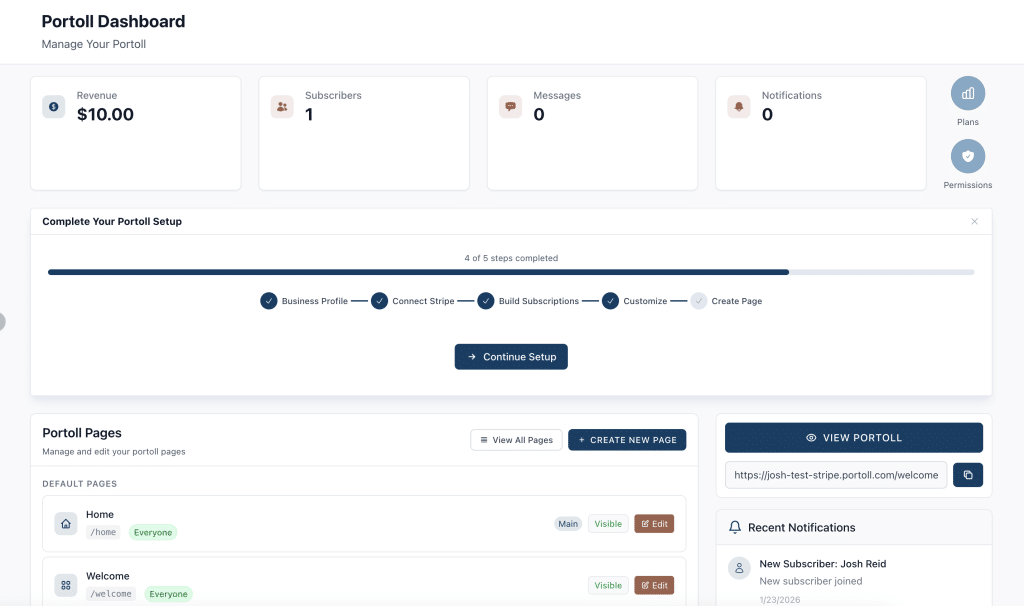
Here are a few key features and benefits that make Portoll stand out:
In short, Portoll offers a one-stop platform to launch and run your subscription-based business. You get the ease of a hosted solution without the downsides of surrendering your control or paying crippling fees. It’s like having a custom-built membership site, but at a fraction of the cost and set up in a fraction of the time.
Portoll’s flexibility means it can accommodate a wide range of subscription models and industries. Individuals and organizations can find innovative ways to use the platform. Here are just a few examples of who can benefit from Portoll:

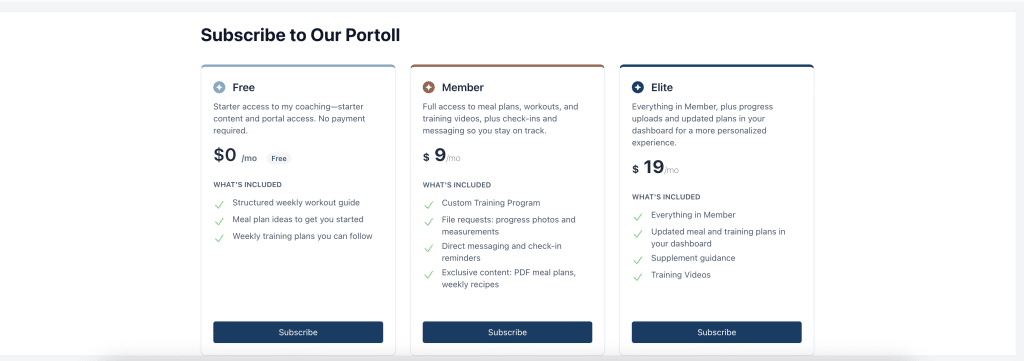
These are just a handful of scenarios – in reality, any situation where you have content, services, or an experience that people are willing to subscribe to can be realized on Portoll. The platform supports free or paid memberships, one-time or recurring payments, and combinations thereof, so you can get creative in designing your offering. You might run a hybrid model (e.g. free basic content plus a paid “premium” section), or offer subscription products that traditionally weren’t online at all (for instance, a local theater could use Portoll to create a membership site for season ticket holders with exclusive behind-the-scenes content). Because Portoll caters to both individuals and businesses, it’s versatile enough to handle use cases from a solo content creator’s fan club to a company’s customer portal.
The old way of building a subscription platform – either coding it yourself, hiring developers, or settling for a one-size-fits-all service – made the barrier to entry quite high. Portoll changes the game by giving you a launchpad into the subscription economy that is fast, affordable, and empowering. With the subscription market growing so rapidly, there’s a real advantage in being able to get your idea to market quickly and iteratively improve it, rather than spending a year in development or losing a big cut of your earnings to a third party.
If you’ve been dreaming about starting a subscription-based service or turning your existing content/business into a recurring revenue model, there’s no better time to jump in. Portoll makes it simple to go from idea to a live membership site in days or even hours. No more procrastinating due to technical headaches or budget fears.
Ready to join the subscription revolution on your own terms? Portoll is here to help you do it. You can get started right away – just sign up on Portoll and begin creating your site. In a few minutes, you’ll be setting up your subscription plans, uploading content, and inviting your audience to become subscribers. What will you create with Portoll? The possibilities are endless, and we can’t wait to see your subscription vision come to life on the platform.
(Stay tuned for future blog posts where we’ll dive deeper into specific industries and advanced tips for succeeding with subscription models. The subscription economy is the future – and with Portoll, you’re ahead of the curve.)
References:
1. Subscription Economy Growth – World Finance / Zuora: The global subscription economy reached $492.34 billion in 2024 and is projected to grow to over $1.5 trillion by 2033[2][3]. Subscription businesses collectively grew 435% from 2012 to 2022[4], far outpacing traditional businesses. Subscribers also generate 3-5 times more revenue over their lifetime compared to one-off customers[5].
2. Planning a Membership Site – eLink Design: Successful subscription websites require careful planning of the business model, understanding of target audience value, and realistic market share expectations (e.g. planning for 1-2% conversion of a market vs. an overly optimistic 50%)[6][7].
3. Features Needed for Subscription Sites – eLink Design: Key components of a subscription-based website include user registration/login, a members-only area, subscription management and renewal functionality, payment processing integration, configurable pricing plans, content management (CMS), and security considerations[8][10]. Integrating all these requires significant expertise[12].
4. Cost of Building vs. Using a Platform – Reddit (web_design forum): Web developers estimate that building a custom subscription web application can cost roughly $5,000-$20,000 (USD) depending on scope, even for an MVP (minimum viable product)[13]. This high cost and time investment historically made it difficult for smaller creators or organizations to launch membership sites.
5. Patreon Fees for Creators – Patreon Help Center / Analyses: Patreon’s platform fees range from 8-12% of creator earnings (10% for most new creators), and payment processing fees typically add ~3% + $0.30 per transaction. All told, creators often lose around 13-15% of each pledge in fees[14]. (For instance, on a $5 pledge, about $0.75 might go to Patreon and payment fees.) This significantly reduces take-home revenue and is a pain point Portoll aims to solve by charging much lower fees.
6. Portoll’s Purpose – USPTO Trademark Filing: Portoll is a Software-as-a-Service platform for “the creation of membership-based websites” and “the monetization of membership-based websites”[15]. In practice, this means Portoll provides a hosted solution with all the software needed to run a subscription or membership site, allowing users to launch their own branded subscription platforms quickly and with minimal cost.
[1] [6] [7] [8] [9] [10] [11] [12] Subscription Based Websites – eLink Design
[2] [3] [4] [5] 40 Subscription Commerce Statistics for 2025: Growth Trends, Revenue Benchmarks & Retention Insights | Swell
https://www.swell.is/content/subscription-commerce-statistics
[13] Cost estimation of subscription based website : r/web_design
[14] How much does Patreon cost? Hidden fees and additional charges …
https://whop.com/blog/patreon-cost
[15] PORTOLL – eLink Design Incorporated Trademark Registration

How Portoll Helps:
Result:
Miguel provides a secure, private, and professional environment for tutoring—and can scale to dozens or hundreds of students without drowning in email.
How Portoll Helps:
Result:
Alexa delivers a premium coaching experience with a system that scales as her business grows. Her subscribers get a streamlined and professional platform that enhances accountability and results. She spends less time managing logistics and more time inspiring transformation.
How Portoll Helps:
Result:
John spends less time organizing and following up, and more time delivering value. His clients appreciate the professionalism and ease of use.